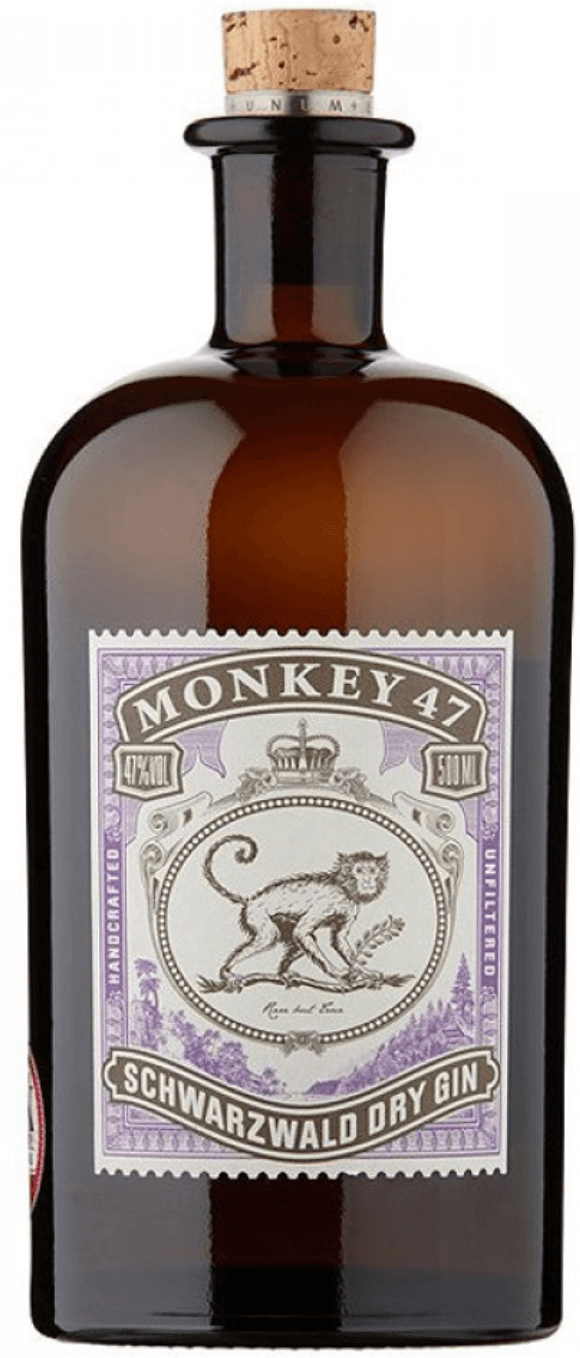
Monkey 47 Schwarzwald Dry Gin
Pernod Ricard (Monkey 47, est. 2010) · Black Forest Distillers, Lossburg, Baden-Württemberg, Germany
Monkey 47 is what happens when obsession meets the Black Forest. Alexander Stein, the founder, wasn’t content with the standard gin playbook of six to ten botanicals. He sourced forty-seven — roughly a third from the forest surrounding his distillery — including lingonberries, spruce shoots, bramble leaves, and acacia flowers. The result is aged three months in traditional earthenware crocks before bottling, a resting step almost no other gin producer bothers with. At 47% ABV (of course), it has the structure to support all that botanical complexity without collapsing into confusion. The fact that it comes in a 375 mL bottle at a premium price has done nothing to slow demand — proof that obsessive quality creates its own market.
Nose
Lingonberry, juniper, black pepper, lavender, citrus peel, pine needles, and a complex herbal bouquet that reveals new layers with every sniff.
Palate
Extraordinarily complex — cranberry, juniper, white pepper, honey, dried herbs, floral notes, citrus oil, and a bitter-sweet interplay that keeps shifting across the palate.
Finish
Remarkably long with lingering pepper, forest botanicals, citrus zest, and a dry herbal quality that evolves for minutes.
- Botanicals
- 47 botanicals including lingonberry, blackberry, spruce, lavender, acacia, pomelo, verbena — ~15 from the Black Forest
- Base Spirit
- Molasses spirit, cut with Black Forest spring water
- Distillation
- Macerated and distilled in a small Arnold Holstein copper pot still; rested 3 months in earthenware crocks
Cocktail Suggestion
Cocktail — The Black Forest Collins: 1.5 oz Monkey 47 · ¾ oz fresh lemon juice · ½ oz lingonberry or cranberry syrup · 3 oz club soda · fresh thyme sprig. Build over ice in a tall glass. The lingonberry syrup amplifies what’s already in the gin, while the thyme bridges the herbal botanicals.
Food Pairing
Pair with: Black Forest ham with cornichons and mustard on dark rye. A regional pairing for a regional gin — the botanicals echo the forest, the pepper spice matches the mustard, and the lingonberry acidity cuts through the richness of the ham.
Be the first to comment.
Leave a comment

St. George Dry Rye Reposado Gin
St. George Spirits
St. George's barrel-aged rye gin sits at the crossroads of whiskey and gin, using fire twice — once to dry-roast botanicals, once through barrel maturation. The result is a gin with structure and warmth that holds up beautifully in stirred cocktails where a London Dry would feel thin. A bridge bottle for whiskey lovers exploring gin.

Beefeater Burrough's Reserve Oak Rested Gin
Beefeater
Master Distiller Desmond Payne's vision of what happens when the spirit meets the cask is brought to vivid life in Burrough's Reserve Oak Rested. Rested in hand-selected Jean de Lillet oak casks — previously used to age the storied French aperitif — this gin embodies the issue's theme at its most literal: the barrel's inner skin imparts golden color, vanilla richness, and a gentle tannic framework without ever eclipsing the juniper-forward London Dry character. It occupies a fascinating middle ground between gin and aged spirit, rewarding both neat sipping and barrel-aged cocktails.

Bols Genever Barrel Aged 18 Month
Bols
A masterclass in patience applied to the gin family tree. Where most gins celebrate the instant brightness of distillation, Bols Barrel Aged 18 Month embraces the slow alchemy of oak and time. The result is a spirit that bridges the worlds of aged whiskey and botanical distillate — furnace-forged grain spirit tempered into something deeply contemplative. Perfectly aligned with "The Furnace of Patience," this genever proves that even the juniper berry bows to time's authority.

Tanqueray Flor de Sevilla Gin
Tanqueray
Tanqueray Flor de Sevilla takes the classic London dry structure and overlays it with actual Seville orange botanicals, creating a gin that bridges tradition and accessibility. The bitterness of the orange is key — this is not a sweetened citrus gin but a genuine botanical expression. A versatile bottle for cocktails and a solid G&T anchor.