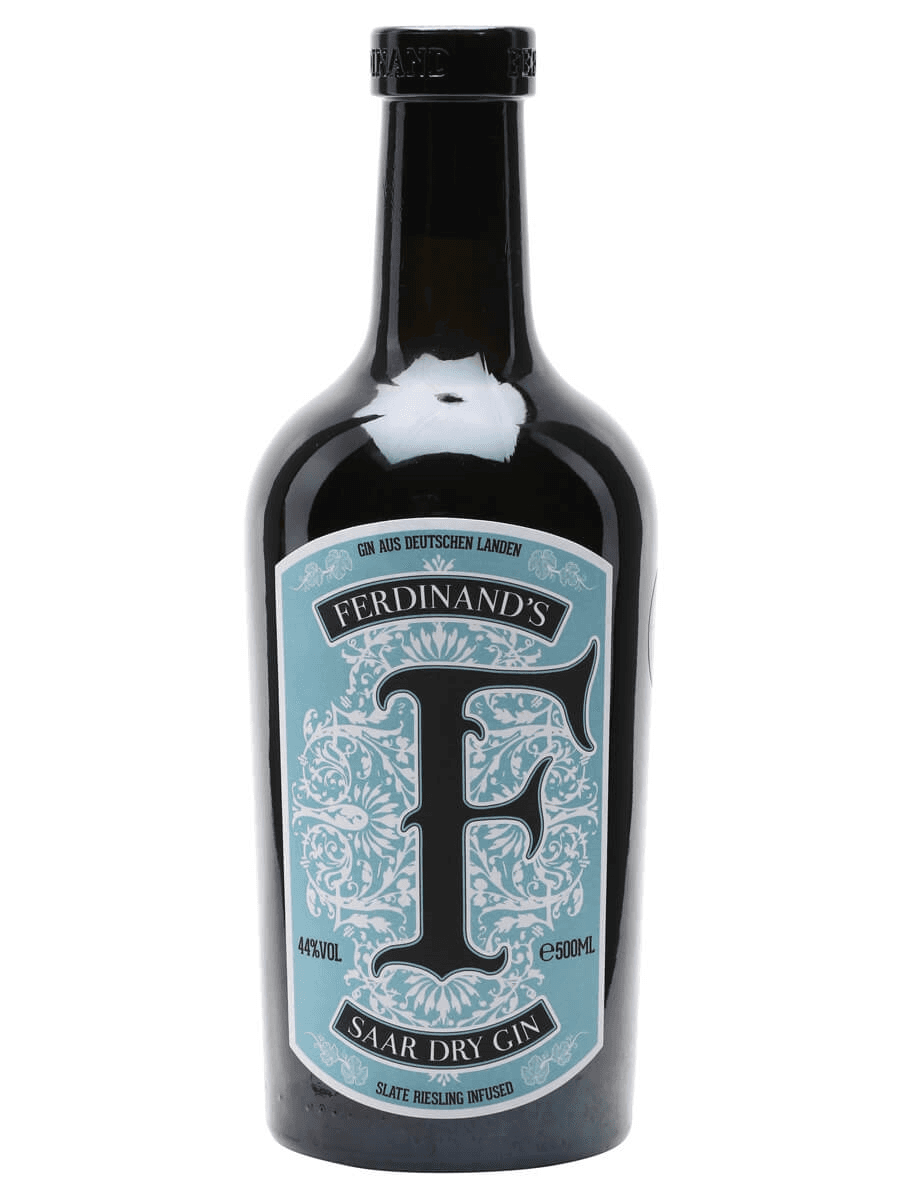
Ferdinand’s Saar Dry Gin
Avadis Distillery GmbH · Avadis Distillery, Wincheringen, Saar Valley, Germany
Ferdinand’s Saar Dry Gin is the rare bottle whose catalyst is literally an ingredient no one else has thought to add. The Riesling infusion does not make this a wine-flavored gin — it is subtler and more structural than that. The wine contributes acidity, a floral lift, and a mineral backbone that unifies over thirty disparate botanicals into a coherent whole. Juniper leads as it should, but the Riesling gives the gin a vinous complexity that makes it equally compelling neat, in a Martini, or in a G&T. At under forty-five dollars, Ferdinand’s offers something unlike anything else on the gin shelf — and that novelty is backed by impeccable distilling craft.
Nose
Juniper and lavender open cleanly, followed by rose petal, citrus zest, and a distinctive vinous note — the Riesling adding a honeyed, almost petrol-tinged complexity that sets this apart from any London Dry.
Palate
Silky and layered. Juniper remains the backbone, but the Riesling infusion adds a floral-acid brightness and grapey sweetness that weaves through the botanicals. Midpalate reveals coriander warmth, sloe berry tartness, and a gentle herbal bitterness.
Finish
Medium-long and elegant. Lavender and rose linger alongside a clean, slate-like minerality that echoes the Saar Valley’s terroir. The finish is dry but not austere.
- Botanicals
- Over 30 regional botanicals including juniper, sloe berries, rosehip, angelica, hop blossom, lavender, quince, lemon thyme, almond shell, coriander, ginger, plus Riesling grape infusion from the Zilliken estate
- Base Spirit
- Grain spirit
- Distillation
- Small-batch pot still with maceration and vapor infusion; Riesling infusion; 4-week stoneware rest
Cocktail Suggestion
Cocktail — "The Saar Martini": Stir 2.5 oz Ferdinand’s Saar Dry Gin with 0.5 oz dry vermouth and a dash of grapefruit bitters over ice for 30 seconds. Strain into a chilled coupe and garnish with a grapefruit twist. The Riesling’s acidity replaces the need for extra vermouth, making this a beautifully balanced, almost wine-like Martini.
Food Pairing
Pair with: Pan-seared trout with brown butter, capers, and a squeeze of lemon. The gin’s herbal-floral notes complement the fish while its Riesling acidity mirrors the caper brine.
Be the first to comment.
Leave a comment

St. George Dry Rye Reposado Gin
St. George Spirits
St. George's barrel-aged rye gin sits at the crossroads of whiskey and gin, using fire twice — once to dry-roast botanicals, once through barrel maturation. The result is a gin with structure and warmth that holds up beautifully in stirred cocktails where a London Dry would feel thin. A bridge bottle for whiskey lovers exploring gin.

Beefeater Burrough's Reserve Oak Rested Gin
Beefeater
Master Distiller Desmond Payne's vision of what happens when the spirit meets the cask is brought to vivid life in Burrough's Reserve Oak Rested. Rested in hand-selected Jean de Lillet oak casks — previously used to age the storied French aperitif — this gin embodies the issue's theme at its most literal: the barrel's inner skin imparts golden color, vanilla richness, and a gentle tannic framework without ever eclipsing the juniper-forward London Dry character. It occupies a fascinating middle ground between gin and aged spirit, rewarding both neat sipping and barrel-aged cocktails.

Bols Genever Barrel Aged 18 Month
Bols
A masterclass in patience applied to the gin family tree. Where most gins celebrate the instant brightness of distillation, Bols Barrel Aged 18 Month embraces the slow alchemy of oak and time. The result is a spirit that bridges the worlds of aged whiskey and botanical distillate — furnace-forged grain spirit tempered into something deeply contemplative. Perfectly aligned with "The Furnace of Patience," this genever proves that even the juniper berry bows to time's authority.

Tanqueray Flor de Sevilla Gin
Tanqueray
Tanqueray Flor de Sevilla takes the classic London dry structure and overlays it with actual Seville orange botanicals, creating a gin that bridges tradition and accessibility. The bitterness of the orange is key — this is not a sweetened citrus gin but a genuine botanical expression. A versatile bottle for cocktails and a solid G&T anchor.